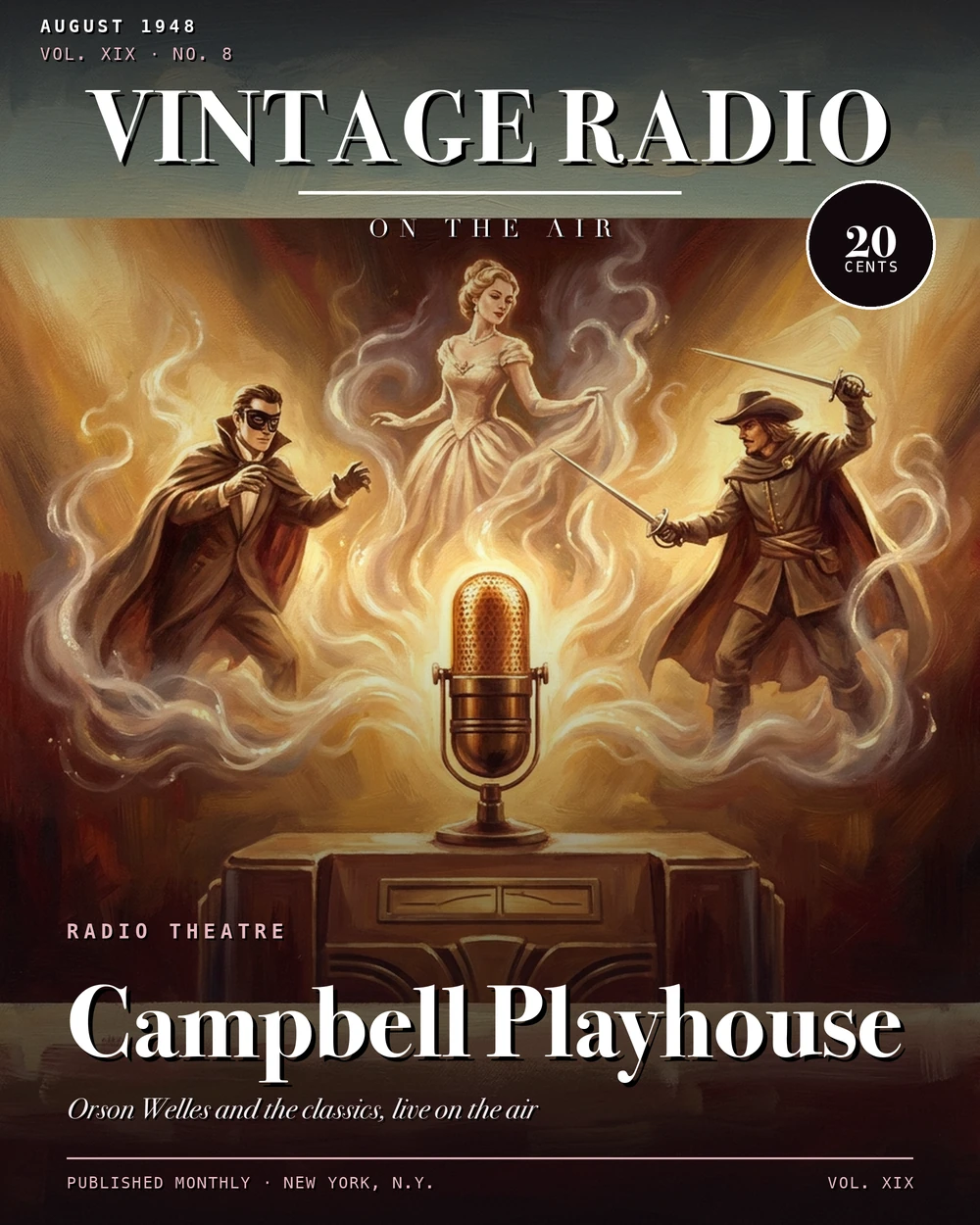
Campbell Playhouse
How It Came Together
The Campbell Playhouse was born from one of the stranger moments in American broadcasting history. On Halloween night 1938, Orson Welles and his Mercury Theater on the Air staged their adaptation of H.G. Wells's The War of the Worlds and triggered a nationwide panic. Within weeks, Campbell Soups — which had just watched its previous vehicle, the variety hour Hollywood Hotel, fade and close that December — moved quickly to attach itself to the most talked-about name in radio. The Campbell Playhouse premiered on CBS on December 9, 1938, and the transition was immediate enough that the opening broadcast leaned directly into the notoriety Welles had been trying to live down the month before.
That first broadcast was an adaptation of Daphne du Maurier's Rebecca, introduced by newsman Edwin C. Hill, with Margaret Sullavan and Mildred Natwick as guest stars and du Maurier herself interviewed live from London at the close of the hour. Bernard Herrmann wrote a complete original score for the broadcast; associate producer Paul Stewart called it "absolutely beautiful," and Herrmann later mined its main theme for his score to the 1943 film Jane Eyre. Welles laid out his ambitions plainly: the new show would tackle "all kinds of stories, mostly modern, and all of them chosen for their suitability to this medium." It was a practical statement as much as an artistic one. With Campbell Soups now providing a genuine operating budget, the show could do things the unsponsored Mercury Theater on the Air simply couldn't afford.
The First Run: Welles and the Mercury Players
During its initial run — Friday nights at 9 PM through 1938–39, then Sunday evenings at 8 PM through the spring of 1940 — the Campbell Playhouse kept the Mercury Theater's core company intact. Ray Collins, Agnes Moorehead, George Coulouris, Frank Readick, Georgia Backus, Bea Benaderet, Everett Sloane, and Edgar Barrier all carried over from the Mercury ensemble. John Houseman stayed on as producer, and Howard Koch handled the adaptations until The Glass Key in March 1939, after which he left for Hollywood and was succeeded by Howard Teichmann, who had started as a stage manager for the Mercury in 1938 and would later co-write The Solid Gold Cadillac with George S. Kaufman. Herrmann continued as composer. The whole operation ran under a theme most listeners would recognize immediately: Tchaikovsky's Piano Concerto No. 1 in B-Flat Minor.
The budget changed the character of the show in one important way. Campbell's money made it possible to hire major film names, and Welles used that leverage. Bringing in stars of that magnitude was good business for the sponsor and good publicity for the show, but it pushed the Mercury Players steadily into supporting positions. The people who had been the ensemble's backbone were now providing the furniture around bigger marquee names.
The material ranged from literary adaptation to popular entertainment. The first season ran through The Count of Monte Cristo, The Magnificent Ambersons, A Farewell to Arms with Katharine Hepburn, Les Misérables with Walter Huston, Lost Horizon with Ronald Colman, Arrowsmith with Helen Hayes, and The Citadel with Geraldine Fitzgerald. A non-musical Show Boat paired Margaret Sullavan as Magnolia with Welles as Cap'n Andy, Helen Morgan returning to the role of Julie that had made her famous, and author Edna Ferber stepping in to play Parthy. May 1939 brought the first radio performance of Thornton Wilder's Our Town, with Welles as the Stage Manager. Lighter fare turned up too: a State Fair with Freeman Gosden and Charles Correll appearing in character as Amos and Andy, June Moon with Jack Benny, and Lionel Barrymore making what became an annual tradition by performing A Christmas Carol at Christmas.
Behind the Scenes: Mankiewicz, Bourbon, and the Slow Exit
The first run looked smooth on the air but was steadily fraying behind it. After Welles signed with RKO in August 1939, he began commuting from Hollywood to New York for the Sunday broadcasts, and the production itself relocated to Los Angeles that November. Screenwriter Herman J. Mankiewicz was put on the Mercury payroll and wrote five scripts for the show between November 1939 and March 1940 — including Dodsworth, Vanity Fair, and a Mr. Deeds Goes to Town whose Viennese psychiatrist was named, as an inside joke, "Dr. Herman Mankiewicz." In December 1939, after an argument over finances, Houseman resigned and went back to New York; two months later Welles hired him back to collaborate with Mankiewicz on Citizen Kane.
The other source of friction was the sponsor. After roughly twenty shows, Campbell's advertising agency took complete control of story selection, and Diana Bourbon — an account executive from the Ward Wheelock agency — became de facto producer. She and Welles clashed regularly. Story proposals were refused; rights to Wuthering Heights, Rogue Male, and The Little Foxes couldn't be secured. When Welles left, he was blunt about why: "I'm sick of having the heart torn out of a script by radio censorship." The final Welles broadcast, on March 31, 1940, was a reprise of Jane Eyre; he had wanted to do Alice Adams and been told no.
The Second Run: A Different Show
When the Campbell Playhouse returned in November 1940 — Friday nights at 9:30 PM, now trimmed to 30 minutes — the most important thing about it was who wasn't there. The show was rebuilt under director George Zachary, with Lyn Murray leading the orchestra and Del Sharbutt announcing. Houseman wrote scripts every other week and alternated with veteran radio writer Wyllis Cooper, with additional contributions from Norman Corwin and Ellery Queen; Diana Bourbon, by then one of the few women directing in network radio, produced. Cooper and announcer Ernest Chappell would later create the horror anthology Quiet, Please.
The guest-star model continued. Humphrey Bogart, Fredric March, Mary Astor, and Jeanette MacDonald all appeared. Eddie Cantor headlined The Nervous Wreck. Fred Allen starred in Corwin's My Client Curley. Randolph Scott, Frank Morgan, and Helen Twelvetrees turned up in The Go-Getter. Lionel Barrymore returned once more for A Christmas Carol. Ratings were actually higher than they had been under Welles — but the show was expensive, and Campbell pulled the plug. The final broadcast aired on June 13, 1941.
The People Behind the Sound
The Campbell Playhouse was never a one-person show, even when Welles dominated the credits. Houseman's steady hand as producer gave both runs their organizational backbone. Herrmann's scoring in the first run brought the same musical intelligence he'd applied to the Mercury broadcasts. Koch handled the early adaptations before leaving for the screenplay work that would eventually include Casablanca. Sound effects were managed by Bill Brown, John Cuomo, and Harry Essman — the practical craftsmen who made radio drama feel real in an era when there was nothing else to look at. Paul Stewart served as associate producer and frequently stepped into the cast; he would turn up in Citizen Kane the following year. Joseph Cotten worked steadily across the Welles broadcasts and would follow Welles into Citizen Kane, The Magnificent Ambersons, and Journey into Fear.
The Mercury Players themselves — Moorehead, Collins, Coulouris, Sloane, and the rest — were the connective tissue of the first run. They could handle any role, shift from drama to comedy to period piece, and make a guest star look good without upstaging them. The budget may have pushed them into the background, but they were the reason the show sounded as assured as it did.
What Survived
The Campbell Playhouse ran for roughly two and a half years across both its incarnations, producing hour-long drama at a level that was unusual for the medium at the time. The first run documented what Welles and his collaborators could do when given resources: literary adaptations produced with the same seriousness the Mercury had brought to its unsponsored broadcasts, alongside lighter popular material that showed the range the company had developed. The second run was a smaller, shorter operation, but it sustained the format and kept the guest-star tradition going through its final broadcast in June 1941.
The show sits at a specific moment: immediately after The War of the Worlds made Welles a nationally known figure, and before his attention shifted fully to Hollywood. The radio work that followed the panic of October 1938 was, in some ways, the most commercially visible Welles ever did on the medium — and the Campbell Playhouse was where most of it happened. The Mercury Theater on the Air was inducted into the National Radio Hall of Fame in 1988, the same year Houseman died; Welles had gone three years earlier.